
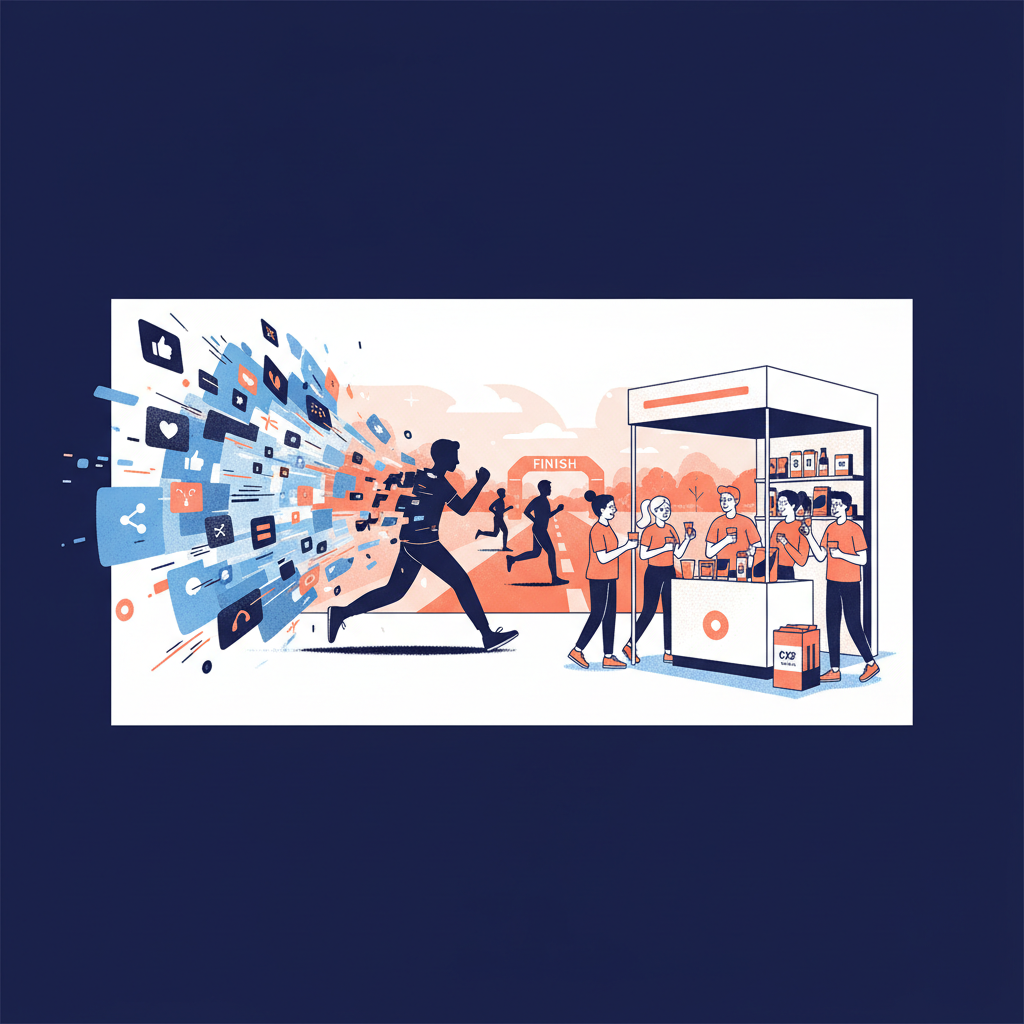
Paid social has become the default growth engine for many consumer brands, especially on Meta. It is easy to launch, simple to scale, and comes with dashboards that make performance feel crystal clear. For a while, it can look like the entire growth story. But when one platform quietly becomes responsible for most of your new customers, you are not just scaling, you are taking on risk. This article is about how to reduce that risk without blowing up what already works.
At RunReach, we work with CPG and other consumer brands that want measurable growth from real-world experiences. We see the same pattern again and again: Meta powers the early curve, then CAC climbs, margins shrink, and leadership starts asking what comes next. Our view is direct: healthy CPG growth needs a channel mix where online and offline work together, and where IRL environments prove their value as a performance engine, not just a brand line item.
When Paid Social Hits the Ceiling
Meta became the go-to for CPG brands because it checks all the boxes. Quick campaign launches, instant feedback loops, broad reach, and clear performance metrics make it feel like a growth cheat code. When investors, boards, or executives ask for fast results, it is natural to lean harder on the one channel that can show ROAS in a slide deck by next week.
This is where the Meta Dependency Trap forms. When a single performance channel drives most of your new customer acquisition, your growth, forecasting, and even internal planning start to orbit around that platform. Budget cycles become a conversation about how much more you can push there, not whether you should.
The problem is not that Meta is bad. The problem is that it is incomplete. Sustainable CPG growth, especially for products bought in the physical world, requires channels that blend measurable performance with real brand building. That is where IRL touchpoints, supported by an IRL marketing platform, need to sit alongside paid social instead of trailing behind as an afterthought.
How Single-Channel Growth Quietly Erodes Brand Health
Once Meta becomes the primary engine, attribution bias starts steering strategy. In-platform reporting highlights what is easiest to count, which is usually last-click or short-window conversions. Activities that build demand over weeks or months, or that influence in-store behavior, rarely get the same credit, even if they are quietly doing the heavy lifting.
This bias pushes teams into short-termism. When every weekly review starts with ROAS screenshots, anything that does not spike immediate conversions looks like waste. Over time, brands over-invest in retargeting, discount-driven creative, and bottom-of-funnel tactics, while under-investing in the brand building that actually creates preference.
At the same time, CAC often rises. Auction dynamics, creative fatigue, privacy changes, and competition for the same lookalike audiences push costs up and predictability down. For CPG brands, where margins are already tight and many purchases happen offline, this can squeeze profitability quickly.
There is also a quieter cost, which is brand commoditization. Over-optimizing for clicks encourages lookalike creative and generic claims. When your main testing ground is a crowded feed, differentiation often takes a back seat to whatever headline drives the cheapest clicks. On a physical shelf or in a marketplace search result, that sameness can be deadly.
Why CPG Brands Need Real-World Touchpoints to Scale
Most CPG purchases still happen in person. People discover, try, and buy snacks, beverages, supplements, and personal care products in stores, gyms, studios, and at events. Yet many budgets skew heavily digital, aiming to influence a purchase behavior that is ultimately offline and context-rich. This creates a disconnect between where we spend media dollars and where our consumers actually make choices.
IRL experiences close that gap. Sampling, event activations, and real human interaction do something a feed ad cannot: they give people a physical, sensory, and social experience with your product. For better-for-you, performance, and wellness products, that lived experience matters. The taste of a drink after a run, the feel of a supplement routine explained by a real person, the brand that shows up to support a local race, all of these create memory and trust.
Active communities are especially powerful here. Fitness, running, and wellness groups tend to over-index on household income, discretionary spend, and cultural influence. When these consumers adopt a product, they talk about it, share it, and often bring it into their workplaces and social circles. For modern CPG brands that want to be part of a lifestyle, not just a transaction, these communities are a fit that paid social alone struggles to replicate.
Turning IRL From Brand Spend Into a Performance Engine
The old story about IRL marketing is that it is soft, hard to measure, and mostly about vague awareness. That story is outdated. When we pair events, sampling, and experiential activations with the right technology, we can treat them like performance channels, complete with clear inputs, outputs, and optimization loops.
This is where an IRL marketing platform comes in. A platform like RunReach helps brands:
Identify and target specific communities, such as runners, fitness enthusiasts, and wellness groups
Standardize activations, so each event follows a proven playbook instead of starting from scratch
Capture first-party data at the point of experience
Measure trial, repeat behavior, and downstream lift
Closing the loop is the key. IRL touchpoints should feed into digital journeys, not sit on an island. That can include:
QR flows that guide people from an activation to a specific offer or product education
Offer redemptions that tie back to retailers or DTC channels
CRM capture that allows follow-up with tailored content
Geo-lift analysis to understand how activations influence sales in surrounding stores
When IRL is wired this way, it stops being a fuzzy brand bucket and becomes a trackable contributor to growth.
Building a Channel Mix That De-Risks Meta Dependence
To escape the Meta Dependency Trap, we have to shift from thinking in single channels to thinking in portfolios. That means building a mix where no one platform can jeopardize growth, and where touchpoints reinforce each other across the customer journey.
A practical allocation model might look like this in early stages:
Maintain Meta as a core engine, but cap its share of total acquisition
Use search and retail media to capture intent closer to the point of purchase
Invest in creator content that can be repurposed across platforms
Layer in an IRL marketing platform to reach high-intent communities in the physical world
The goal is not to turn anything off overnight. It is to gradually move from a situation where Meta is the single point of failure to one where Meta is one of several strong pillars.
For IRL, we recommend test-and-learn rather than large, one-off bets. Start with small, repeatable activations across multiple events or communities instead of one giant sponsorship. Define clear success metrics, such as sample-to-signup rate, offer redemption rate, and lift in sales in targeted geos. Over time, these tests roll up into a repeatable playbook your team can scale.
Action Plan to Escape the Meta Dependency Trap
The first step is diagnosis. Brands can ask themselves:
What percentage of new customers are driven by Meta right now?
If Meta performance dropped suddenly, how exposed would our revenue be?
How much of our budget supports channels that influence offline purchase, not just online clicks?
Do we have measurement frameworks that value demand creation, not only last-click conversion?
Next, design your first IRL performance tests. Focus on communities where your target consumer already spends time, like running events, studio classes, or wellness festivals. Clarify your objective, whether it is trial, CRM growth, or geo-lift at a specific retailer. Build simple, friction-light QR flows and offers that make it easy to move from real-world interaction into your digital ecosystem.
Finally, commit to a balanced growth model. We see IRL not as a replacement for Meta, but as the missing layer that turns offline experiences into measurable, performance-driven growth. When brands treat real-world marketing with the same rigor they bring to paid social, they gain something Meta alone cannot provide: diversification, deeper brand connection, and a channel mix resilient enough to support real, long-term CPG growth.
Turn Offline Moments Into Measurable Growth With RunReach
If you are ready to turn real-world interactions into trackable results, our IRL marketing platform is built to help you do exactly that. We work with you to plan, launch, and measure in-person campaigns that connect authentically with your audience. Share a bit about your goals and we will recommend a tailored approach for your next activation. Have questions or a unique idea in mind? Contact us so we can explore what is possible together.