
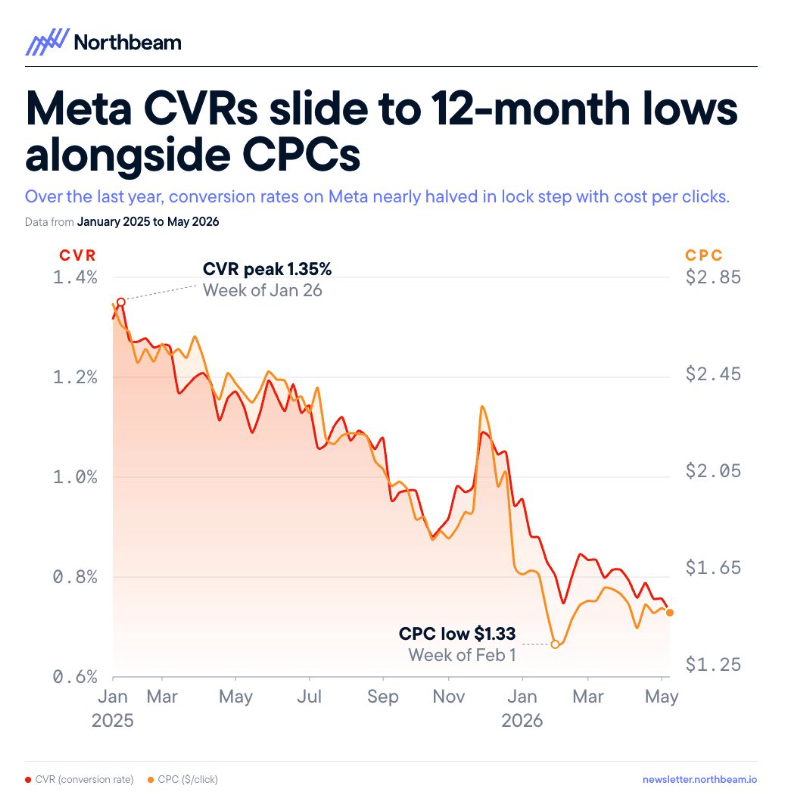
The data is in, and it's brutal.
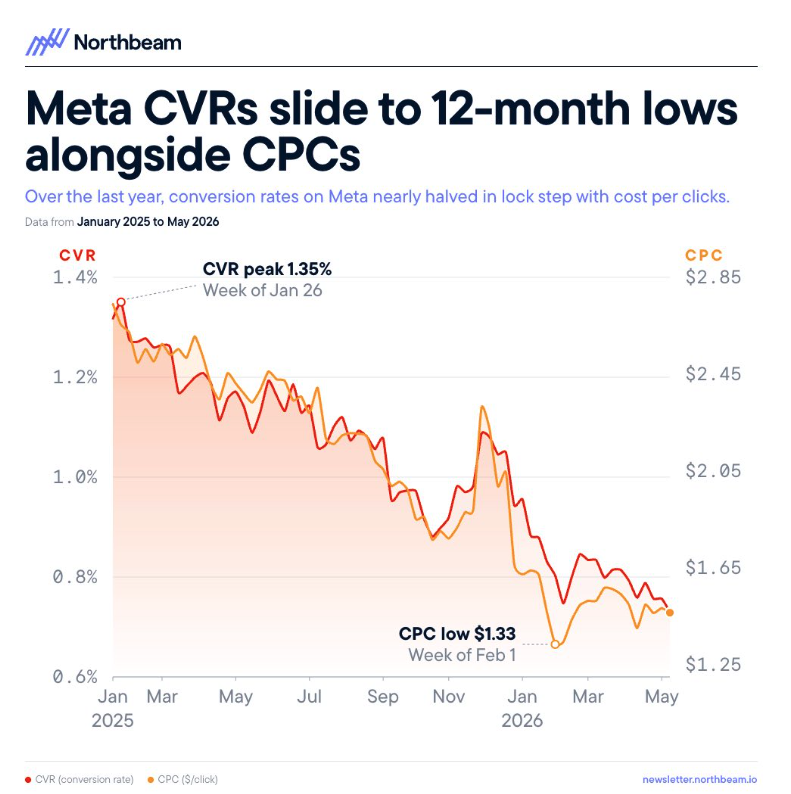
According to Northbeam, Meta CPCs have hit 12-month lows, but here's the twist: conversion rates have cratered right alongside them. CVRs have nearly halved since January 2025, moving in lockstep with cost-per-click as both slide toward the floor. Cheaper clicks haven't bought better outcomes. They've just made the dysfunction cheaper to ignore.
For brands that have built their entire growth engine on Meta, this isn't a blip. It's a reckoning.
The "Shitty Clickthrough" Trap
There's a principle in marketing known as the Law of Shitty Clickthroughs, coined by Andrew Chen. The idea is simple and unforgiving: every advertising channel degrades over time. Banner ads once had 70%+ click-through rates. Then users learned to ignore them. Email open rates were once extraordinary. Then inboxes became a war zone. Every channel follows the same arc: novelty, scale, saturation, decay.
Meta is not exempt from this law. It just took longer because the targeting was genuinely excellent and the inventory was genuinely massive. But the trajectory is now clear.
The brands that got hurt the worst are the ones that confused "what's working now" with "what will always work." They optimized so deeply into Meta that diversifying felt like a risk. Now staying feels like the bigger one.
This Isn't Just a Meta Problem. It's a Mindset Problem.
Here's what actually separates great marketers from average ones: great marketers are always looking around the corner. They don't wait for performance to collapse before they experiment. They allocate a portion of budget to channels that aren't yet saturated, not because those channels are proven, but because that's how you find the next thing before everyone else does.
The brands currently scrambling to diversify away from Meta are paying tuition on a lesson that was always available. The law of channel degradation isn't new knowledge. It's just easier to ignore when the numbers are green.
Savvy marketers stay uncomfortable on purpose. They test early, learn fast, and show up on channels before the CPMs inflate and the creative fatigue sets in.
Right now, that channel is IRL.
The Comeback of Real Life
While digital feeds have become an arms race of interruptions, something counterintuitive has happened: real-world, in-person marketing has quietly become one of the most underpriced, highest-attention touchpoints available.
People are fatigued. They scroll past ads they've seen a dozen times. They've trained themselves to ignore sponsored content. But they haven't trained themselves to ignore a real experience: a product placed directly in their hands, a brand message delivered in a context they actually care about, a moment that feels earned rather than bought.
The best consumer brands have always understood this intuitively. Sampling at farmers markets. Event sponsorships. Community partnerships. The problem was never the strategy, it was the scalability. You couldn't run IRL marketing like performance marketing. There was no dashboard. No targeting. No measurable attribution.
Until now.
IRL, Built Like Performance Marketing
RunReach exists because this gap was too big to ignore.
We've built the infrastructure to treat IRL marketing the way performance marketers have always wanted to: with targeting, with measurement, with scale, and without the operational lift that used to make it inaccessible to growth teams.
Here's what that looks like in practice: brands choose their audience, set their budget, and activate. RunReach handles everything else: placing your product, sample, coupon, or branded insert directly into the hands of highly targeted consumers through one of the most receptive contexts available: endurance races and fitness events.
These aren't passive eyeballs. These are active achievers: high-income, health-conscious consumers who are already in a mindset of investment, aspiration, and performance. The demographic profile skews exactly where brands in health, food, nutrition, wellness, and lifestyle want to be.
And the touchpoints are genuinely different. Racer kits have a near-100% open rate. Targeted sampling delivers your product into someone's hands at the exact moment they're most receptive. Strategic signage at high-traffic event points reaches thousands of engaged consumers in a single activation. Branded gear that people actually want to wear turns your customers into ambassadors.
Brands like Chomps, GEM, Flow Hydration, Ancient Nutrition, Habit Burger, Mezcla, and PopUp Bagels have already figured this out. They're not here because Meta stopped working. They're here because they understand that the brands that win are the ones that show up where their customers live, not just where they scroll.
Why This Makes Everything Else Work Better
There's a multiplier effect to IRL marketing that pure digital channels can't replicate.
When a consumer encounters your brand at an event - holds your product, sees your logo at the finish line, finds your insert in their race kit - something changes in how they process you digitally afterward. Your retargeting ads look familiar instead of intrusive. Your Meta creative lands differently because there's real-world context behind it. Your email open rates tick up because your brand has earned a small piece of mental real estate that no algorithm gave you.
Channel diversification isn't just risk management. Done right, it's a force multiplier. IRL investment doesn't replace digital, it amplifies it.
The Takeaway for Marketers
If your Meta performance is sliding, you already know it. The question isn't whether to diversify - it's where, and how fast.
The brands that come out of this cycle stronger won't be the ones that found a better Meta strategy. They'll be the ones that used this moment as a forcing function to build a channel mix they should have had years ago.
The next high-attention, under-priced channel is already here. It just doesn't look like an ad unit.
RunReach connects consumer brands with millions of health-conscious, high-income consumers through endurance events and fitness activations, all managed through a centralized, performance-marketing-style dashboard. No lift on your end. Real results.