
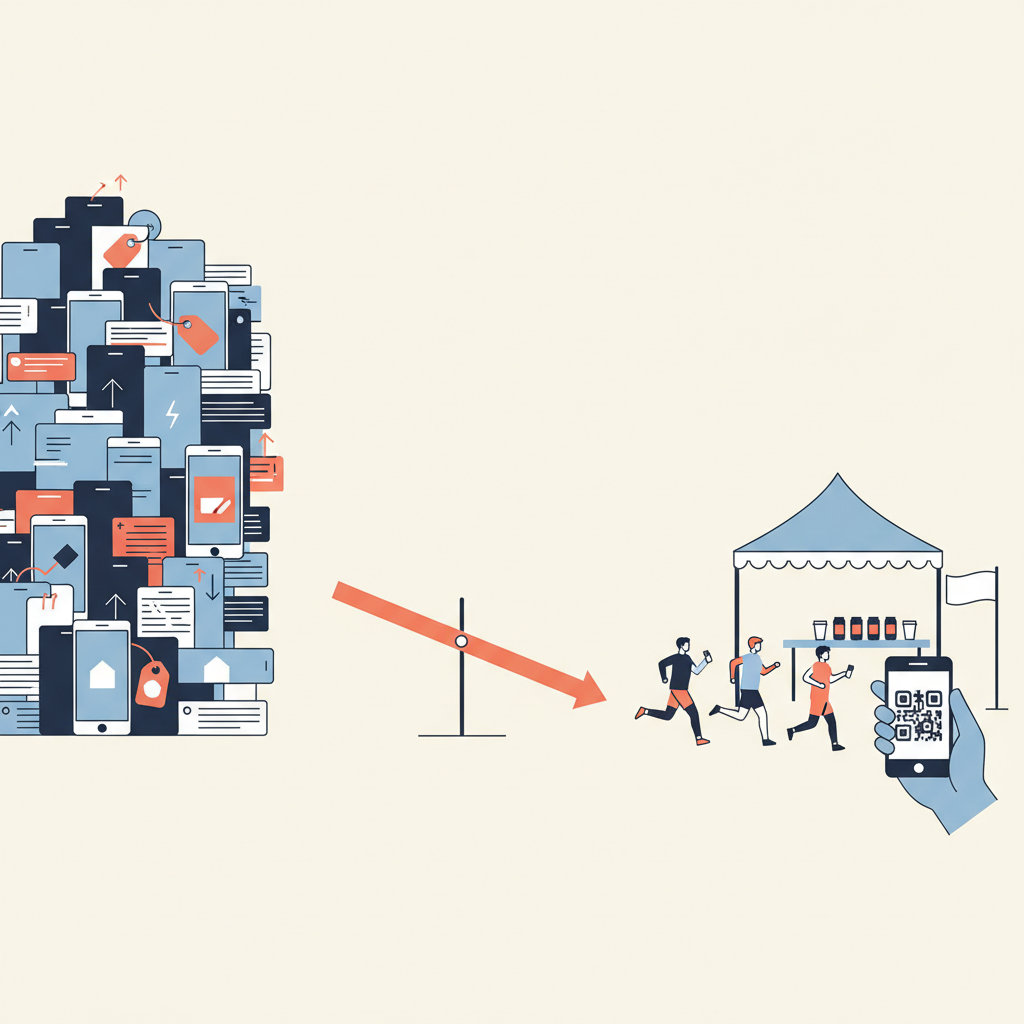
CPG and consumer brands have poured so much money, time, and attention into digital and retail media that one powerful growth channel has quietly been left on the sidelines. Real-world activation, especially around athletic and community events, is still treated as a nice-to-have instead of a core part of the media plan, even though it puts products in the hands of exactly the people many brands care about most: active, high-income adults.
In this article, we will walk through why real-world activation is still underpriced, how an IRL marketing platform like RunReach turns it from scattered sampling into a scalable growth engine, and what it takes to design campaigns that actually move the numbers your team reports on. If you work in brand, growth, shopper, or field marketing and you are feeling the ceiling on digital performance, this is for you.
Meet Your Most Overlooked Growth Channel
Real-world activation is not just about sponsoring a race and putting a logo on a banner. When we talk about real-world activation today, we mean structured brand experiences in the places people already gather in person: local runs, fitness communities, athletic events, neighborhood gatherings, and other community-based moments where people are showing up with intent and attention.
These are environments where people are already acting like the consumers you want: they are making time for wellness, investing in their routines, and trying new products that fit their lifestyle. Yet many CPG brands still treat this as one-off event marketing, handled manually, with inconsistent execution and limited data.
Our perspective at RunReach is that this should be its own channel, just like paid social or retail media. An IRL marketing platform can centralize planning, standardize activation, and collect clean performance data so teams can finally treat real-world experiences as a repeatable, measurable part of the growth mix.
Why Digital Spend Is Sky-High but Impact Is Leveling Off
Digital performance media, search, and retail media have grown steadily more expensive while returns for many brands have flattened. Targeting is more restricted, auctions are more crowded, and the days of cheap, easy wins are mostly gone. You can still reach people, but you pay a premium to stand out in feeds that are already overflowing with ads.
On top of that, privacy changes and cookie deprecation have made it harder to see the full customer path. Signal loss chips away at the clean attribution that once justified more budget. For CPG in particular, where much of the purchase still happens at retail, it can be tricky to connect digital impressions to incremental buyers in a way that everyone across the organization trusts.
Contrast that with what happens at a community race, a weekend fitness festival, or a local run club meet-up. There are fewer brands competing for attention, people are physically present and engaged, and your product can be integrated into an experience they care about. While digital channels feel crowded, real-world spaces still have white space, especially when you think in terms of organized, repeatable activations instead of sporadic sponsorships.
The Real Economics of Real-World Activation
When you meet people in real life at events they already value, you are reaching an audience that is often high-intent, high-income, and actively making purchase decisions that align with health, performance, and lifestyle. For many CPG and consumer brands, that is the exact segment the media plan is built around.
The economics start to look compelling when you think in terms of cost per qualified interaction instead of cost per thousand impressions. A real-world activation can deliver:
Direct conversations with people who fit your target profile
Product trial in the moment, not just an impression on a screen
Context that makes your brand more memorable and relevant
Permissioned data capture that powers follow-up and retargeting
Historically, the downside of event marketing has been that it was manual and fragmented. Each event was a one-off project, with scattered assets, inconsistent staffing, and limited learnings from one market to another. An IRL marketing platform is designed to flip that equation by standardizing logistics, training, creative, and measurement, so what used to be occasional stunts becomes an always-on acquisition and trial channel.
Turning Moments Into Measurable Outcomes
The real power of modern real-world activation is that it no longer has to sit in a black box. With the right setup, every interaction at an event can feed into the same data systems your team already uses for digital and retail media.
Some of the most useful tools are simple and familiar:
Unique QR codes tied to specific events, offers, or retailers
Branded landing pages for exclusive event offers or content
SMS or email capture that is fast to complete on a phone
Post-event retargeting flows that continue the relationship
By connecting these elements, you can track how someone moves from an event touchpoint to a retailer visit, subscription, or e-commerce purchase. The key is clean data flows and clear conversion events agreed on upfront, so both brand and growth teams can see the impact in language they recognize, like incremental buyers or repeat purchase rate.
Our role at RunReach is to make that bridge between experiential campaigns and performance metrics feel straightforward. We focus on building campaigns around measurable actions, so you are not just counting how many people walked past a tent, you are tracking how many became buyers you can identify and learn from over time.
Designing IRL Campaigns That Punch Above Their Weight
Treating real-world activation like a serious channel starts with picking the right events and communities. The best fits are where:
The audience matches your core buyer
The geography aligns with key retail partners or target markets
The event cadence supports repetition, not just one-off hits
Once you know where you want to show up, the activation itself needs to do a few things well. It should educate people quickly on what makes your product worth trying, make sampling or trial almost effortless, capture data in a way that feels natural and optional, and clearly show what to do next, whether that is visiting a specific retailer, signing up for a subscription, or joining a loyalty program.
Approach this like you would any media channel. Use a test-and-learn framework, where you experiment with different offers, messaging, and on-site experiences, then standardize what works into playbooks your team can roll out across markets. This is how real-world activation starts to punch above its weight, not through a single big splash, but through consistent, optimized presence in the communities that matter.
From Pilot Test to Scaled Playbook
The best way to start is not by committing a huge slice of budget, but by running a focused pilot across a thoughtful set of events. Define a few clear success metrics that match your broader goals, like cost per trial, cost per new buyer, or retailer lift in activation zip codes. Then plan for rapid learning cycles, so you can adjust creative, offers, and targeting within the season.
As performance data comes in, patterns emerge. You can refine which event types tend to drive the best outcomes, which audience segments convert most efficiently, and which calls to action lead to actual trips to shelf or online purchase. Over time, this turns scattered anecdotes into a strategy you can present in the same way you present digital and retail media performance.
When that happens, it becomes much easier to build IRL into annual planning. The channel can sit alongside digital, retail media, and shopper marketing, with its own budget, forecast, and expected contribution to growth. That is the shift we are aiming for at RunReach: real-world activation treated as a core part of the plan, not an afterthought.
Make Real-World Activation Your Unfair Advantage
Real-world activation is still underpriced because it sits at the intersection of low competition on-site, high consumer receptivity, and steadily improving measurement. While other channels grow noisier and more expensive, the right presence in athletic and community events can quietly outperform on cost per incremental buyer.
Reallocating even a modest share of digital or shopper spend into structured IRL pilots can reveal where this channel fits best in your mix. When supported by an IRL marketing platform that makes execution repeatable and outcomes measurable, those real-world moments stop being soft-brand plays and start acting like a dependable performance channel for your team.
Turn Real-World Moments Into Measurable Growth
If you are ready to turn offline interactions into trackable results, our IRL marketing platform can help you bridge the gap between physical touchpoints and digital performance. At RunReach, we work with you to design, launch, and optimize campaigns that fit your brand and your goals. Have questions or a specific idea you want to explore together? Contact us to start planning your next IRL activation.