
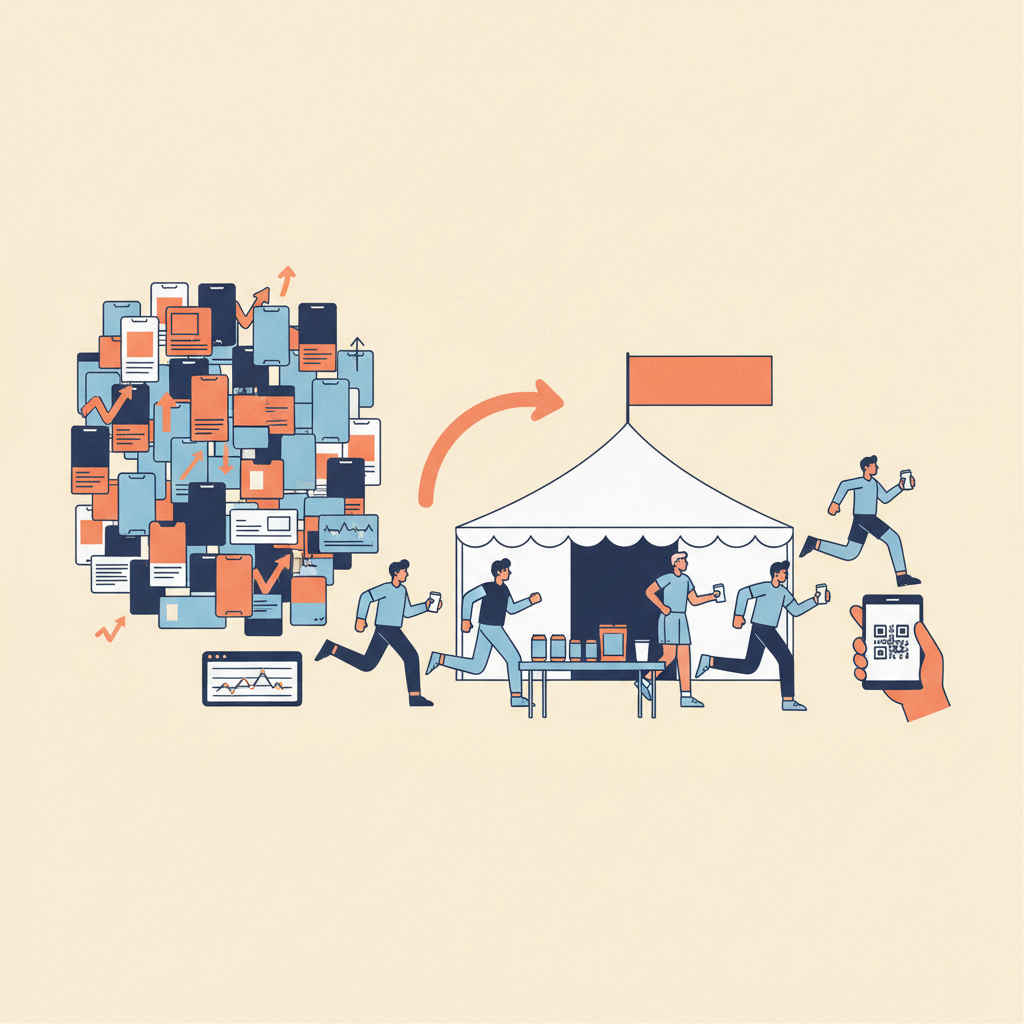
CPG channels are crowding faster than most teams can update a media plan. Paid social, retail media, and influencer programs are all fighting over the same attention, which means rising costs, noisier feeds, and less reliable returns for the same budget. If your growth depends on one or two of those channels, you can feel that tension every time you refresh your dashboard.
Channel saturation for CPG is what happens when a once-great channel starts demanding more money and more discounts just to hold flat. Customer acquisition cost creeps up, incrementality slips, and creative that used to pop now blends in. On the retail side, shelf visibility that you once earned with velocity now depends on paid search placements and paid tiles, which turns your trade budget into a constant bidding contest.
Our core belief at RunReach is that the smartest CPG marketers do not wait for performance to fall apart before they react. They build systems that show them saturation early, then move budget into underpriced, real-world attention while it is still quiet. IRL channels, when supported by an IRL marketing platform, can be measured, tested, and scaled with the same rigor as digital, without joining the same CPM arms race.
Spotting Channel Saturation Before Your Dashboard Shows Red
By the time ROAS or MER looks ugly, the real damage is already done. Those are lagging indicators, the result of weeks or months of your audience seeing the same formats and offers on repeat. To stay ahead, we need leading indicators that tell us when a channel is getting tired long before finance starts asking hard questions.
Some of the earliest signs of saturation show up inside platform metrics that often get skimmed:
Impression growth slowing at the same budget and audience size
Frequency rising while click-through rate and engagement stay flat or fall
Greater dependence on promo codes, coupons, or deep discounts to hit the same volume
Retail media placements becoming table stakes for visibility you once earned organically
When we zoom out from high-level dashboards, cohort and geo analysis become powerful. Savvy CPG teams break down performance by region, retailer, and audience segment. One retailer might start showing slower new-to-brand growth before others. Some cities might hit creative fatigue faster because your ideal buyers in those areas are more active shoppers.
Outside of paid metrics, early warning also lives in brand signals. Slower growth in branded search, softer organic social chatter, or slipping share of voice in category conversations can all hint that your paid channels are starting to overwork the same people. The goal is to spot these patterns while things look fine at a distance, so testing new channels feels proactive, not desperate.
Building a Channel Portfolio Built to Outlast Algorithms
Relying on a single hero channel can feel satisfying when it is working, but it is risky. The better mindset is a channel portfolio, similar to how an investor spreads risk across asset classes. We plan for some channels to be workhorses and others to be our next wave of growth.
A thoughtful portfolio maps channels by three dimensions:
Stage of the funnel: awareness, consideration, conversion, and loyalty
Level of competition and cost pressure inside each channel
Measurability and speed of learning so we know how fast feedback will arrive
With that map, we can design a testing framework that runs while existing channels are still performing. That usually means small, defined test budgets, clear hypotheses about what we expect a new channel to do, and fixed time windows to collect learnings. The point is not to replace a hero channel overnight; it is to have the next candidate ready when the hero starts to fade.
A modern portfolio also balances screen-based media with physical-world touchpoints. Experiential moments, sampling, and event-based interactions reach consumers when they are engaged in something they care about, not scrolling past ads while half distracted. For CPG brands, that might mean runs, fitness events, or community gatherings where your product naturally fits into the experience.
Why IRL Marketing Is the Next Underpriced Attention Layer
As digital acquisition costs climb and tracking gets fuzzier, real-world settings with intent-rich audiences are becoming more valuable for CPG. When people show up at a run or a fitness event, they have signaled something specific about their interests, habits, and often their income level. That context is stronger than a vague interest-based audience online.
Modern IRL marketing for CPG is not about random sampling tables or generic sponsorship logos. It is about tightly aligned activations at events where your target buyers already are: runs, races, fitness gatherings, studio events, and lifestyle meetups. When someone finishes a workout and encounters a product that fits into their routine, the message feels relevant instead of interruptive.
Historically, offline activations were messy. It was hard to find the right events, coordinate logistics, and prove results at scale. That is where an IRL marketing platform like RunReach comes in. By centralizing event sourcing and targeting, handling logistics and staffing, and standardizing data capture, a platform helps turn IRL from a one-off experiment into a consistent channel.
That data layer is what lets IRL play nicely with digital. You can drive QR scans, coupon redemptions, and signups that feed back into your CRM or media platforms. Those contacts become high-intent retargeting audiences, and the events themselves can drive both retailer and DTC conversion in the days and weeks that follow.
Using an IRL Marketing Platform to Stay Ahead of the Curve
So how do we fold IRL into an existing media mix in a way that feels systematic, not random? It starts with the same discipline you bring to digital. First, define the audience in practical detail: for many consumer brands, that could be high-income, wellness-focused people who invest in their health and enjoy active community experiences.
An IRL marketing platform makes it easier to translate that audience definition into specific event types. We can match to runs, fitness gatherings, or boutique studio events where that profile naturally concentrates. From there, we align offers and messaging to the context: post-workout recovery, convenient better-for-you swaps, or performance-focused benefits that resonate with how attendees see themselves.
Measurement is what turns this into a repeatable strategy instead of a one-off experiment. Before an event, we set clear goals, such as:
Product trial and sampling volume
List growth or first-party data capture
Retail sell-through or DTC lift in nearby zip codes
Then we instrument the activation. That can include unique coupon or QR codes tied to specific retailers, tracking local retail velocity in the weeks after events, and looking for repeat purchase signals where data is available. Over time, these results can feed into media mix models or incrementality studies so IRL is evaluated with the same rigor as digital.
The strategic advantage of doing this through a platform like RunReach, rather than ad-hoc sponsorships, is repeatability. When event selection, logistics, and measurement are standardized, it gets much easier to run multi-market tests, compare performance across locations, and quickly scale what works into a durable, less saturated channel.
A Playbook to Future-Proof Your CPG Channel Mix
Future-proofing your mix is less about chasing whatever channel is trending and more about continuously building what comes next before performance forces your hand. The shift is mental: from reacting to channel decay to expecting it, then planning for it with structured experimentation.
A simple, recurring routine helps. Many teams benefit from quarterly channel health reviews that include early-warning checks, not just last period ROAS. Layer in a dedicated budget line for testing underused channels, with IRL marketing as a key candidate while digital rates stay elevated. Then, honestly audit how dependent you are on one or two paid channels, and use that insight to prioritize where your next tests should start. IRL, powered by an IRL marketing platform, is one of the most practical ways to start building a real-world audience engine while many of your competitors are still crowding the same screens.
Turn Real-World Moments Into Measurable Growth
If you are ready to connect your brand with people in the real world and actually track the impact, our IRL marketing platform is built for you. At RunReach, we help you plan, launch, and measure campaigns that turn in-person experiences into real results. Tell us what you are trying to achieve and we will show you a strategy that fits your goals. Have questions or a complex idea to discuss, just contact us and we will walk you through the next steps.